
Dawn Speaks · Draft 4, revised November 3, 2026
Positioning & Messaging Framework
The position, the messages that carry it, the proof behind them, and the voice they are written in. This framework informs the website and the language used to introduce Dawn’s work across programs, proposals, presentations, and other communications.
01
Strategic Foundation
The central idea, the human truth, what makes Dawn distinct, and the principle that guides the work.
01.1 The central idea
Leave bigger than you started.
Growth is not about fixing what is wrong or becoming someone else. It is about understanding yourself more fully, recognizing what has shaped how you see yourself and others, and seeing possibilities you may not have considered.
01.2 The human truth
We can mistake what we’ve learned to be for all we can become.
Default settings become so familiar that we stop questioning them.
01.3 Dawn’s distinction
She understands what goes unsaid, and she knows when to say it.
Dawn’s great-grandmother taught her discernment: read the situation, keep your intentions close, and know when to speak, when to listen, and when to move. So Dawn hears what people hold back without judging them for it, names it when the moment is right, and trusts people to bear it.
The four parts of Dawn’s distinction
- Understanding, not sharper eyesight. “I see what others miss” describes better perception. Dawn’s claim is understanding. Her great-grandmother taught her that “not everyone needs access to your intentions or your next move,” and Dawn knows from the inside why people hold back: to protect themselves, out of timing, or as strategy. So she reads silence without treating it as deception or failure. She can name what’s unsaid without shaming anyone, because she respects why it went unsaid.
- Timing. Her directness is chosen, not reflexive. “There’s power in knowing when to speak, when to listen, when to reveal your hand.” She says the hard thing when a person or a room can hear it, which is why it lands. The approved Home hero already carries this: “The Room Goes Quiet, Then Dawn Speaks.”
- Trust in people’s capacity. “God don’t give you more than you can bear.” Dawn trusts people can handle the truth about themselves, so she neither softens it into nothing nor rescues them from it. Her candor is a form of respect.
- A lineage, not a borrowed method. Her great-grandmother’s lesson lives in SPEAKS. Space, Pinpoint, Examine, and Ask are walking slow: read the situation before you move. Knuckle Down and Say & Stand are hitting the corner and running. Her distinction comes from her family, not just from a certification.
Why it matters. Many coaches claim directness or insight. Few can show where their judgment comes from, and fewer can show it in a story. Dawn can, in her great-grandmother’s own words.
01.4 The principle that guides the work
Know better, do better.
Once you see something you hadn’t seen before, you have a choice about what happens next.
02
Positioning Statement
The agreed answer to who Dawn works with, what she brings, and what changes. Every piece of copy starts here.
Positioning statement
Dawn Speaks helps leaders and teams leave bigger than they started. Raised by a great-grandmother who taught her discernment, she has spent a lifetime deepening her understanding of people through formal learning and more than 25 years in leadership development. Dawn hears what people hold back without judging them for it, names it when the moment is right, and trusts people to bear it. Through honest conversation and a readiness to address what others avoid, she helps them recognize what they may have overlooked, expand their beliefs about what is possible for them, and act on what they discover.
03
Brand Platform
The logic behind the position: who the work is for, what people are up against, why Dawn’s approach is distinct, and what the work promises.
Category
Leadership development, including executive coaching, team restabilization, keynotes, and workshops. Cultural competency runs through the work as a practice, not as the headline.
Target
Leaders, teams, and organizations or speaking audiences. The Audiences & Site Doors section describes each audience and its needs.
Insight
People can become so accustomed to how they see themselves, how they lead, and how things work that they stop questioning the limits they’ve accepted. Those default ways of thinking can keep other possibilities out of view.
Root strengths
More than 25 years in leadership development, working with people at every level, from individuals finding their voice to CEOs leading complex organizations. ICF accreditation and experience building leadership programs for a global beauty company. A distinctive approach rooted in the discernment her great-grandmother taught her and built on through formal learning and professional experience: she hears what people leave unsaid, understands why, and knows when to bring it into the conversation.
Points of parity
Credentials, confidentiality, references, and a clear first step. Every buyer expects them. The site states each plainly and does not present them as the difference.
Benefits
For leaders: A fuller understanding of themselves and clarity about what they want to stand behind.For teams: A clearer view of the dynamics shaping their work and new possibilities for how they relate.For audiences: Questions that challenge familiar thinking and ideas they can put into practice.For organizations: The potential for stronger trust, wider buy-in, and performance that holds up over time.
Values
Website expression: Core valuesThese are the concise, reader-facing expressions of the values below. They are written as principles people can recognize and act on, rather than abstract value labels.Integrity: Be who you say you are.Your word should hold its shape under pressure. What you promise on Monday still stands on Friday.Lineage: Choose what you carry.Learn from your roots and the road you’ve walked. Keep what strengthens you, set down the rest.Discernment: Know when to move.Patience isn’t standing still. Watch, listen, and wait for your moment, then move with intent.Candor: Keep it 100.Say what’s real, kindly and directly. People can handle the truth when it comes with respect.Commitment: Go all in.Halfway rarely changes anything. Put your full effort behind what you’ve chosen, and stay with it.Strategic meaningIntegrity: Be who you say you are.Truth that’s yours to own: The truth people find with Dawn belongs to them. She is never there to beat anyone up with it.Choosing freely: The most powerful action is one you choose, knowing what you know.Responsible for the action: Not perfection. Owning the choice and its outcome, whether it works or not.
Personality
Direct, with timing. Dawn says what needs to be said and gets to the point, at the moment it can be heard.Kind, in the same breath. The challenge comes with warmth. She names what went unsaid without shaming anyone for it. Humor can be at her own expense or the room’s, never at the expense of the person doing the work.Insightful and invested. She listens closely, pays attention to what people leave unexplored, and brings observations into the conversation without claiming to know someone else’s truth for them.Accountable, and holding you to it. She asks people to stand behind their choices and take responsibility for what follows.Curious. She questions familiar explanations and looks for what may be missing.Funny. Humor makes room for honesty without diminishing the seriousness of the work.
Reasons to believe
The call-back: A global beauty company took Dawn’s work in-house, the work later came apart, and the CEO called her back.The referral: The chief of staff at a national philanthropic foundation recommended Dawn to coach a senior executive after one weekend of facilitation.The range: Experience across a design school, a youth mentoring organization, an after-school program, and conference stages for a global beauty company.The stage: Keynotes to audiences of up to a thousand on cultural competency and leadership.The facts: More than 25 years in leadership development, ICF accreditation, and 50K+ people in the room.SPEAKS: Dawn’s own method: six practices arranged around you, beginning with Space and not running in a straight line.
Discriminator
Dawn brings together wisdom passed down through her family lineage, Bronx grit, formal learning, and more than 25 years in leadership development. She listens beyond what is said, paying attention to what people leave out and the patterns shaping how they see themselves and others. She brings those observations into honest conversation, helping people examine their own assumptions and take responsibility for what they choose to do next.
Promise
People leave with a fuller understanding of themselves and the situations they face, a wider view of what may be possible, and greater clarity about what they choose to do next.
Essence
Become who you say you want to be without giving up who you’ve been.
04
Brand Story
The story the About page is built from: what Dawn’s life and work taught her.
Hailing from the Bronx, NYC, Dawn was raised by her great-aunt and great-grandmother, who once told her, “When you walk out, you walk slow, but baby when you hit that corner you run!” It was a lesson in discernment before Dawn had a word for it: read the situation, understand the timing, and know when to speak, when to listen, and when to move. That inherited wisdom remains part of the foundation of her life and work.
Years later, in college, broke and finding her own way, Dawn heard her great-grandmother say, “God don’t give you more than you can bear.” Over time, those words grew beyond religion into a philosophy Dawn still lives by: she doesn’t need every answer to trust that she can handle what comes, big or small.
Growing up in the Bronx also shaped Dawn’s connection to hip-hop, a culture rooted in self-expression, storytelling, and finding your voice. Her love of spoken word carries that creative impulse forward, giving her another way to explore the stories people tell, the experiences that shape them, and the power of putting words to what might otherwise go unsaid.
For more than 25 years, Dawn has worked with people at every level, from individuals finding their voice to CEOs responsible for entire organizations. She has seen talented people make themselves smaller than they are, leaders lose sight of the values they set out to uphold, and teams settle into patterns that no longer serve them. She has also seen what becomes possible when people are willing to look honestly at themselves and change how they show up.
Dawn built leadership programs for a global beauty company, where people felt seen, heard, and valued while remaining accountable for their actions and results. When the company took that work in-house and it came apart, the CEO called her back. The experience reinforced something central to her approach: meaningful change takes more than good intentions. It takes honest conversations, ownership, and a willingness to act.
In 2025, Dawn built Speaks Out Loud around the work she had spent years doing with others and was now asking of herself. She doesn’t believe growth comes from a motivational speech or from being told who to be. Her work begins with honest examination: looking at how people show up, what they have come to accept, and what they may not yet see in themselves. What happens next belongs to them. The challenge is to take what they discover and keep putting it into practice.
05
Key Messages
One core message and three supporting messages: the challenge, the difference, and the outcome. Each has its own job and the relevant evidence behind it. Check every page against these messages before it ships.
Core message
You are more than what you’ve come to know about yourself, and there’s more coming.
Message 1: The challenge
Familiar patterns can limit what we believe is possible.
Over time, inherited ways of thinking become default settings. They show up as the conversation a team keeps putting off, the feedback a leader has heard more than once, or the assumption no one in the room questions anymore.
Proof
- A global beauty company took Dawn’s leadership program in-house. When the work came apart, the CEO called her back.
- Dawn’s readiness intake opens with the question: “What conversations are you currently avoiding or postponing?”
Message 2: The difference
Dawn brings inherited and practice wisdom to the conversation.
Her great-grandmother taught her discernment: how to read a situation, why people keep their next move to themselves, and when it is time to speak. With formal learning and more than 25 years in leadership development behind her, Dawn hears what people hold back without treating it as a failing, names it when the moment is right, and trusts people to handle what they find.
Proof
- The chief of staff at a national philanthropic foundation recommended Dawn to coach a senior executive after one weekend of facilitation.
- Cultural competency is a practice behind her work, from conference stages to executive coaching.
- Her great-grandmother’s lesson, in Dawn’s words: “When you walk out, you walk slow, but baby when you hit that corner you run!”
Message 3: The outcome
A fuller understanding opens up new possibilities. What happens next is yours to own.
Understanding is only the start. Dawn asks people to name what they will do with it and to own the result, without waiting for permission or for complete certainty. In her words: “Knowing what I know, I chose it freely.”
Proof
- When a global beauty company’s work came apart after being taken in-house, the CEO called Dawn back.
- SPEAKS ends with Say & Stand: say the choice clearly, own the outcome, and stand on it.
06
Audiences & Site Doors
The three audiences the site is built for: who they are, what they face, what they need to hear first, and where their door leads.
DOOR 1
The leader
Who
A CEO or senior executive ready to see themselves clearly, whether their title keeps people from speaking candidly, their values and actions no longer line up, or they have been underestimated, overlooked, or conditioned to make themselves smaller.
What they are up against
Intention and action have drifted apart: what they value, what they say, and what they actually do no longer line up as they would like. Their title may make it difficult for others to speak candidly with them. Familiar expectations may also limit what they allow themselves to consider.
What they need to hear first
One to one, Dawn creates room to examine how you show up, question familiar thinking, and understand the relationship between your values and your actions. From there, you choose what you are willing to do, knowing what you know.
First step
The readiness intake, then a first conversation. Start when you’re ready to go all in.
Leads toExecutive Integrity & Impact
DOOR 2
The team
Who
A CEO, chief of staff, COO, or head of people whose leadership team has come apart. This can also be a team that is functioning well and wants to build on its strengths.
What they are up against
Trust is draining and work is suffering. People have become cautious about saying what they see. Those most able to name the problem may have the most to lose by speaking up. An internal fix may already have been tried.For teams that are working well, the work is understanding the self and each other more fully, using overlooked strengths, and choosing together what to aim for. Strong results rarely prompt the hard questions.
What they need to hear first
Dawn helps teams rebuild trust, understand the dynamics shaping their work, and recognize how each person contributes. The aim is to help the team hold true to itself while working out how it wants to operate within the organization and beyond.
First step
The readiness intake, then a call. Dawn says plainly whether the organization is ready for the work.
Leads toTeam Restabilization & Retention
DOOR 3
The room
Who
A conference chair, events or learning lead, dean, or program director booking a date.
What they are up against
A room that has heard it all before, and a budget that needs to show what participants can take away and put into practice after the applause.
What they need to hear first
Keynotes and workshops range from cultural competency to leadership legacy. A keynote that isn’t a lecture: Dawn speaks with people, not at them, asking for answers, inviting disagreement, and letting the exchange set the pace.
First step
Book Dawn: the date, format, audience, and ask.
Leads toIn The Room & On The Mic
07
Services & Definitions
The service names and definitions used on the site, in proposals, and on invoices. Definitions do not include time periods. Pricing is handled separately.
01
Executive Integrity
& Impact
Dawn works with C-suite and senior executives to examine the assumptions behind their success and consider what their next chapter of leadership asks of them. She pushes them to question how they show up, confront gaps between intention and action, and take ownership of their impact.
What it leaves behindA leader whose values, words, and actions line up again, who makes choices freely, states them clearly, and takes responsibility for what follows.
02
Team Restabilization
& Retention
For teams needing a breakthrough, Dawn helps them question familiar patterns, surface unspoken tensions, and understand how individual experience shapes their interactions. The work helps teams turn new understanding into specific changes in how they work independently and together.
What it leaves behindA team with a deeper understanding of its people, a clearer view of what it can accomplish, and greater ownership of how its members work together.
03
In The Room
& On The Mic
Dawn brings candor, cultural insight, and lived wisdom to keynotes and workshops, examining familiar issues from unexpected angles. She invites audiences to connect what they learn to what they do next. No room is too small, no stage is too large: when Dawn Speaks the room listens.
What it leaves behindA room that has examined the subject, considered its own role, and identified what participants can carry forward or put into practice.
08
Her Method: SPEAKS
The six practices of Dawn’s coaching method, in her words. You are at the center, with the six practices around you. Space comes first, because creating space is the precondition for the rest. After that, the practices are not a straight line: people move between them as a situation asks, and can return to any of them.
SPEAKS carries her great-grandmother’s lesson about timing: “When you walk out, you walk slow, but baby when you hit that corner you run!” Space, Pinpoint, Examine, and Ask are the walk, reading the situation before you move. Knuckle Down and Say & Stand are the corner, where you choose and run with it.
S
Space
Permission to create space before responding. Not everything needs an immediate answer.
P
Pinpoint
What is happening, with the facts separated from the story you are telling yourself. Is my response helping or hurting?
E
Examine
Beneath the surface: the people, the systems, the power dynamics, your own patterns. What am I not seeing? What is driving behavior?
A
Ask
Who do I need? What do I need to know? What outcome do I want?
K
Knuckle Down
A choice, never a decision. Knowing what I know, I chose it freely, and now the work of acting on it. Not about perfection; about being responsible to action.
S
Say & Stand
Say the choice clearly, own the outcome, and stand on it. Hold yourself and your leadership to account, and keep holding. You will not know whether it works unless you stick with it.
One rule on every page
A choice, never a decision.
The drawing
The model is drawn as a circle, not a line: you at the center, with the six practices around you, starting from Space. The design carries the drawing; this section carries the words.
08.2
The TALK Framework
SPEAKS is how. TALK is what. The four TALK Tracks are the ground the process covers, with definitions built from Dawn’s own. Each track is a commitment with one job: see what’s real, own it, act on it, understand who’s acting. On the site each track has two tabs, the default and the commitment, with five points each.
TALK enters at Space. Before responding, you look across the four TALK Tracks and set which of them the moment calls on. The rest of SPEAKS then acts on what Space set: Pinpoint, Examine, Ask, and Knuckle Down do the work, and Say & Stand puts the choice out loud.
T
Truth
Confronting false narratives and naming what has gone unspoken.
False Narratives: Living Them · Defending Them · Normalizing Them · Silencing Truth · Limited By Them
Liberated Truth: Questioning Them · Challenging Them · Releasing Them · Speaking Truth · Living In Possibility
A
Accountability
Owning our choices, our conduct, and the impact we leave behind.
Avoidance & Deflection: Avoiding · Justifying · Blaming · Resisting · Repeating
Ownership & Integrity: Owning · Acknowledging · Accepting · Correcting · Sustaining
L
Leadership In Action
Translating intention into meaningful action and lasting results.
Passive Leadership: Avoiding · Reacting · Controlling · Inconsistent · Undermining
Intentional Leadership: Deciding · Leading · Empowering · Modeling · Cultivating
K
Knowing Yourself
Understanding patterns and reactions to make conscious choices.
Disconnected Self: Losing · Ignoring · Reacting · Seeking · Abandoning
Conscious Self: Recognizing · Examining · Managing · Affirming · Honoring
Her guiding idea
Leadership starts with the conversations we’re willing to have, especially the ones we have with ourselves.
09
Proof Points
The evidence behind the key messages, written in two forms: what can be said now and what may be said once each client agrees to be named.
| Proof | Said now | Once named |
|---|---|---|
| The call-back | A global beauty company took Dawn’s work in-house, watched it come apart, and brought her back. She now works one to one with the CEO on trust and organizational integrity. | The same sentence with the company and CEO named, with the CEO’s testimonial beside it, only after written permission. |
| The referral | The chief of staff at a national philanthropic foundation referred Dawn after one weekend of facilitation. In her words: “And that was just one weekend with me.” | The foundation named, along with the portfolio she supported, only with permission. |
| The range | A design school. A youth mentoring organization. An after-school program. A global beauty company’s conference stages. | Each organization named as a client, with approval. |
| The stage | Keynotes on a national conference stage, speaking on topics from cultural competency to leadership legacy. | A clip on the site, once recordings are cleared and event details are confirmed. |
| The facts | More than 25 years in leadership development. ICF-accredited coach. 50K+ people in the room. |
10
Competitive Alternatives
Each service has its own alternatives, written as they appear on its page. They are not necessarily wrong for every situation. Each has limits that can matter when a leader, team, or audience needs to examine assumptions, speak honestly, and follow through.
Executive Integrity & Impact
Why Honest Feedback Seldom Reaches The Top
Performance coaching, 360 reviews, and a trusted inner circle all have value. None are built to say the hard parts plainly and see it through.
Alternative 1
A performance coach
What usually happens
The aim is hitting targets and sharpening skills. Attention stays on what you do, and rarely touches how you show up for others.
Where Dawn is different
Dawn looks at what your results rest on, the assumptions beneath them, and whether those will hold up in your next chapter.
Alternative 2
A 360 review
What usually happens
Ratings arrive filtered and softened. A title makes people cautious, and the finished report too often ends up in a drawer.
Where Dawn is different
Dawn says what she notices, one to one, free of org-chart politics, and remains with you while you work out your response.
Alternative 3
Your inner circle
What usually happens
Trusted peers and advisors know you well, and often share your blind spots. Loyalty holds the hardest message back for years.
Where Dawn is different
Dawn has no stake in keeping you comfortable. She names the gap between intention and action and asks you to own your impact.
Team Restabilization & Retention
Why Internal Fixes, Workshops & Pep Talks Rarely Last
Each has its own value. None are built to surface assumptions, invite honest conversation, and follow through.
Alternative 1
Going in-house
What usually happens
The effort goes to a leader who may be part of the problem. Old patterns hold, and those best placed to speak up have the most to lose.
Where Dawn is different
Where familiar dynamics protect the status quo, Dawn listens beyond what’s said, catches what’s left unspoken, and turns those insights into action.
Alternative 2
More training
What usually happens
A full day of content can seem productive, but it never reaches what sits underneath, so the same habits show up at the next team meeting.
Where Dawn is different
Using her SPEAKS Model, Dawn moves each participant from understanding to a choice they state out loud and stand behind.
Alternative 3
A motivational speaker
What usually happens
A rousing keynote can fire everyone up for an afternoon. Within weeks, every role, rivalry, and quiet rule is back in charge.
Where Dawn is different
Dawn addresses this group’s real relationships, with the candor and cultural fluency that make ideas specific enough to act on.
In The Room & On The Mic
Why A Great Talk Is Often Forgotten By The Next Morning
A motivational speaker and an expert panel both have their place. Neither leaves people with a next step they own.
Alternative 1
A motivational speaker
What usually happens
Everyone leaves lifted, yet the feeling fades without follow-through. Inspiration has value, but rarely shifts much alone.
Where Dawn is different
Dawn skips the applause lines and asks honest questions, so attendees connect what they hear to choices waiting at work.
Alternative 2
An expert panel
What usually happens
Information gets delivered, slides get shared, and difficult subjects stay off the stage. The audience goes home briefed but unmoved.
Where Dawn is different
Dawn turns the topic toward the listeners themselves, making an abstract subject personal, specific, and hard to ignore.
What makes Dawn different
Dawn combines close attention to people with a willingness to raise difficult questions. She helps people examine what they have come to accept, then keeps the responsibility for what happens next with them.
11
Voice & Tone Guide
How every line is written: the traits, the distinctions, the tone by page, the word lists, examples, and the checklist.
Direct
Dawn says what needs to be said and gets to the point, at the moment it can be heard. She does not dress up a difficult truth in corporate language or create confrontation for its own sake.
Example“What I am in the business of is who you’re gonna be today that you said you were yesterday.”
Kind, in the same breath
The challenge comes wrapped in warmth. Humor can be at Dawn’s own expense or the room’s, not at the expense of the person doing the work.
In her words“Always kind, but direct.”
Insightful and invested
Dawn listens beyond what is said. She pays attention to what people leave unexplored and brings observations into the conversation as questions, not as claims to know another person’s truth better than they do.
Avoid generic claims such as “She sees more in people than they may see in themselves” or “Dawn notices what sits beneath the surface” when they merely repeat the same idea.
Accountable, and holding you to it
The choice is named, the outcome is owned, and the next move is in the reader’s hands.
In her words“Knowing what I know, I chose it freely.”
Guiding lineWhat you come to understand matters when you put it into practice.
We write / We never write
| We write | We never write |
|---|---|
| One clear claim after a setup line, addressed to the reader | Slogans or taglines that replace a specific point |
| Warmth around the challenge | Softer, more corporate language designed to make the challenge more acceptable |
| Choice, choosing, and the outcome in the reader’s hands | The words “decision” or “decide,” or promised outcomes |
| Her story as what it taught her | Her identity reduced to a label |
| Her own register | A borrowed voice |
| Growth through fuller understanding, perspective, possibility, and action | Growth framed as becoming a different, better, or more complete person |
Tone by page
| Where | The reader | The tone |
|---|---|---|
| Homepage | Checking quickly whether Dawn is the right person | Direct and matter-of-fact. The claim, then the proof. |
| Service page | Weighing a real problem; the team reader may be in pain | Specific and accountable. Humor at zero. No promises beyond what the service can support. |
| Readiness intake | Unsure whether they are ready; some are not | Plain. It says what readiness means and does not let the reader off the hook. |
| A decline | Possibly stung | Kind, one sentence, never a lecture. Not everything needs an immediate answer. |
| Stage page | Booking a date and format | One notch warmer. This is where the room gets to hear Dawn. |
Words we use
Conversation. Examine. Challenge. Confront. Accountability. Ownership. Responsibility. Integrity. Choice. Space. Beneath the surface. How you show up. Possibility. Stability. Hold accountable. Leave bigger.
Words we never use
“Unlock potential.” “Empower,” in any form. “Transformational.” “Journey.” “Thrive.” “Elevate.” “Foster.” “Tailored.” “Passionate.” “Navigate.” “Impactful.” “Thought leader.” “Synergy.” “Best version of yourself.” “One-size-fits-all.” “Decision.” “Decide.”
Avoid em dashes, motivational clichés, formulaic triads, strings of abstract nouns, repeated slogans, and unsupported claims.
Seven writing principles
- Write toward growth, not just repair.
- Tell the truth without reducing people to their problems.
- Make “leave bigger” tangible.
- Connect insight to action.
- Make accountability a choice.
- Respect the person, not just the outcome.
- Sound like a person, not a framework.
The identity and growth rule
Never frame growth as becoming a different, better, or more complete person. People are already who they are. Dawn’s work helps them understand themselves more fully, question what they have come to accept, recognize possibilities they may have overlooked, and choose what to do with what they discover. Dawn won’t make that choice for them or tell them who to be.
Before and after: making the voice distinctly Dawn’s
These examples should show Dawn’s particular way of working: she brings inherited and practice wisdom into the conversation, listens to what is said and left unsaid, questions familiar explanations, and puts the choice and responsibility back with the person or team. They are illustrative copy, not quotations from Dawn.
| Generic or familiar wording | More distinctly Dawn |
|---|---|
| “Build stronger teams through better communication.” | When a team is struggling, the problem is not always what people are saying. It can also be what nobody feels able to say. Dawn helps the team put those tensions on the table and examine how each person is shaping the way they work together. |
| “Become a more effective leader.” | What you value as a leader and what people experience from you may not always line up. Dawn helps you look honestly at that gap and choose what you are willing to do about it. |
| “Unlock new perspectives and possibilities.” | The way you’ve learned to see a situation can start to feel like the only way to see it. Dawn asks what that explanation leaves out, what else might be true, and what you want to do with what you learn. |
| “Leave inspired to make a difference.” | A good conversation can show you something you had not considered. What matters next is what you choose to do with it, and whether you stand behind that choice. |
The checklist: run on every line before it ships
- Would Dawn say it to one person, face to face?
- Is it clearer than it is clever?
- Does the tone match the reader on that page?
- Is every sentence under 25 words where practical, without making the writing choppy or losing necessary meaning?
- Is it free of words on the never-use list, including “decision” and “decide” in brand copy?
- Is Dawn named consistently as Dawn Speaks where the brand name is required?
- Are commas used instead of em dashes?
- Are all numbers accurate and confirmed? Do not introduce a number other than 25+ years unless verified in writing.
- Does the copy preserve the distinction between identity and possibility?
- Does every sentence add something new?
12
Ready-To-Use Copy
These are draft applications for programs, introductions, press pages, and proposals. Review and approve before publication.
One-line description
a program, a meta description
Dawn Speaks works with leaders and teams to question familiar thinking, confront what they’ve come to accept, and put new understanding into practice.
Short bio
an introduction
Raised in the Bronx by her great-grandmother and great-aunt, Dawn brings inherited wisdom, formal learning, and 25+ years in leadership development to her work with leaders and teams. ICF-accredited, she is known for being direct, asking the questions others avoid, and challenging people to examine how they show up. Her work connects honest self-examination with the choice to act on what you learn.
Boilerplate
a press page or a proposal
Dawn Speaks works with CEOs, senior executives, and teams through executive coaching, team restabilization, and interdisciplinary keynotes and workshops. With 25+ years in leadership development and ICF accreditation, Dawn brings inherited wisdom, formal learning, and a direct, compassionate approach to her work. She challenges familiar explanations, helps people examine the gap between what they believe and how they show up, and holds them accountable for what they choose to do next. Her work is grounded in a simple principle: understanding matters when you put it into practice.
13 · Logo
One Logo, Three Shapes
Approved by Dawn, October 22: the mic-in-K lockups (she loves the pink K) with square mark C2, the stacked cut with SPEAKS in Bold at the 192px pixel-hinted size. The stacked mark holds to 48px; below that use the horizontal or mic-only cut. Construction, cuts and floors live on the logo system page.

Stacked · dark. The primary lockup on the stage; holds to 48px tall.

Stacked · light. Full color on icy #F2F5FF.

Stacked · one color. Single ink on white, for print and partner pages that allow one color.
Horizontal · dark. The header cut; use where the stacked mark would fall below its 48px floor.
Horizontal · light.
Horizontal · one color.
Square mark C2 · dark. The stacked cut with SPEAKS in Bold, pixel-hinted at 192px. The mic stays as drawn.
Square mark C2 · light.
Avatar · the C2 circle crop for profile photos and podcast covers.

Mic-only cut · the smallest sizes. The favicon cut is queued, not yet approved.
14 · Color
The Colors Of Her Stage
The stage
#070A1A
Every page floor. Near-black, never pure black.
Panel
#0F1430
Cards and lit panels sit one step off the stage.
Icy
#F2F5FF
All type, every line, full icy. Nothing dimmed grey (Brand Standard 10/29).
Her light
#FF0F8C
Fuchsia is Dawn’s light and the ONLY pressable color. Eyebrow dots default to it off the service pages.
Pressed fill
#E4007A
Button fill on white and solid CTAs: the AA-passing fuchsia (4.59:1 with white at 15px bold). Hover returns to her light.
Executive cue
#0066FF
Cobalt. Executive Integrity & Impact owns it: page eyebrow dots, cue chips, audience tags.
Team cue
#7B2FF7
Violet. Team Restabilization & Retention owns it.
Room cue
#00C9B7
Turquoise. In the Room & On the Mic owns it.
The six SPEAKS lights, layered wherever the model appears:
SSpacePPinpointEExamineAAskKKnuckle DownSSay & Stand
Retired, never reuse: Coral #FF6B4A · yellow as a band · #FF6FB5 · amber · periwinkle · the act gradient panels.
15 · Type
Fraunces Speaks, DM Sans Works
Hero title
Fraunces 300
64 / 44 · 1.0
Dawn-approved (House Lights, option A), line 1.0 as on the specimen she chose. Steps 56 at mid widths, 52 on tablet. Two lines (SPEAKS three); on phones a title decided on two lines scales to hold them (Home 36, Meet 42, Book 41 at 390), every other hero sets at 44. Gradient italic em closes the line.
Section title
Fraunces 300
44 / 32 · 1.0
Every block headline. Line 1.0, Dawn-approved (option A specimen). Full width, no character caps.
Showpiece quote
Fraunces 300 italic
40 / 28 · 1.15
Referral, intermission, pull and press quotes.
Statement
Fraunces 300
36 / 28 · 1.2
The “what it leaves behind” sentence.
Card & row title
Fraunces 300
26 / 22 · 1.15
Work, path and format cards, comparison rows, SPEAKS names, TALK tracks, panels.
Hero lede
Fraunces 300
28 / 22 · 1.25
Placement 1: the line under the hero title, in the display face (Dawn-approved option A), 16 under the title at every width as on her approved specimen; buttons 34 below. 25 at mid widths. Full icy.
Standard lede
DM Sans 400
21 / 19 · 1.5
Placement 2: the line under every block title, and every block-opening paragraph. Full icy.
Body
DM Sans 400
17 / 16 · 1.6
Paragraphs, card descriptions, rows, answers. Full icy, never dimmed.
Question
DM Sans 500
17 / 16 · 1.4
FAQ and readiness questions.
Small
DM Sans 400
15 / 14 · 1.5
Definitions, captions, tab names, form helper text.
Eyebrow
DM Sans 600
12 / 12 · .16em caps
Section eyebrows: cue dot (8px, glowing, page cue), then 14 · 1px hairline · 14 to the title (Dawn-approved specimen). Hero eyebrows, the Explore label and credits never carry the dot. See Block anatomy.
Button & text link
DM Sans 700
15 pill · link 12 caps
Book Dawn pills; Explore / Start here / Book a call links.
Micro label
DM Sans 600
11 / 11 · .14em caps
Pending chips, card tags. The floor of the scale.
Stat numeral
Fraunces 400
40 / 32
Credibility numbers in her light; label 14 caps.
THE BRAND STANDARD, set by Kris on October 29, 2026: every line of text on the site sits on one of these fourteen roles, and every line is full icy #F2F5FF. Only decorative numerals, inactive animation states and UI chrome may dim. Width standard: H1 and H2/ledes run wide, the full content column, no character caps.
16 · Iconography
Original Icons, Never Altered
The locked production set: 193 marks extracted pixel-for-pixel from the approved boards plus 9 all-fuchsia UI utilities.
Originals only
Every mark is the approved board’s own pixels, background removed, color untouched. New marks are extracted, never redrawn; production files live in icons-original/.
The dot is her light
The fuchsia dot is the constant across the set. It marks, it never presses; it is never recolored per page cue.
Ground is part of the mark
Dark-ground marks are icy ink for the stage; light-ground marks are dark ink for icy bands. Use the version drawn for the band it sits on, never invert or recolor one across.
Where each set deploys
SPEAKS marks on the model pages · services marks on route cards and nav · formats, podium & audience on Book Dawn and every “Ways to bring her in” block · journey on the engagement rail · TALK, outcomes and credibility beside their own copy blocks.
One set, one size
The whole production set displays at one uniform size: every mark’s ink fits a standard 60px height (width capped at 118px on the board; the guide grid runs at 90%), and no mark’s dot may render above 20px, and whichever binds tighter sets the scale. Marks only ever scale DOWN from their extracted pixels, never up, so nothing softens. A group may run larger only as a named exception; SPEAKS carries the one approved (×1.25).
Core set
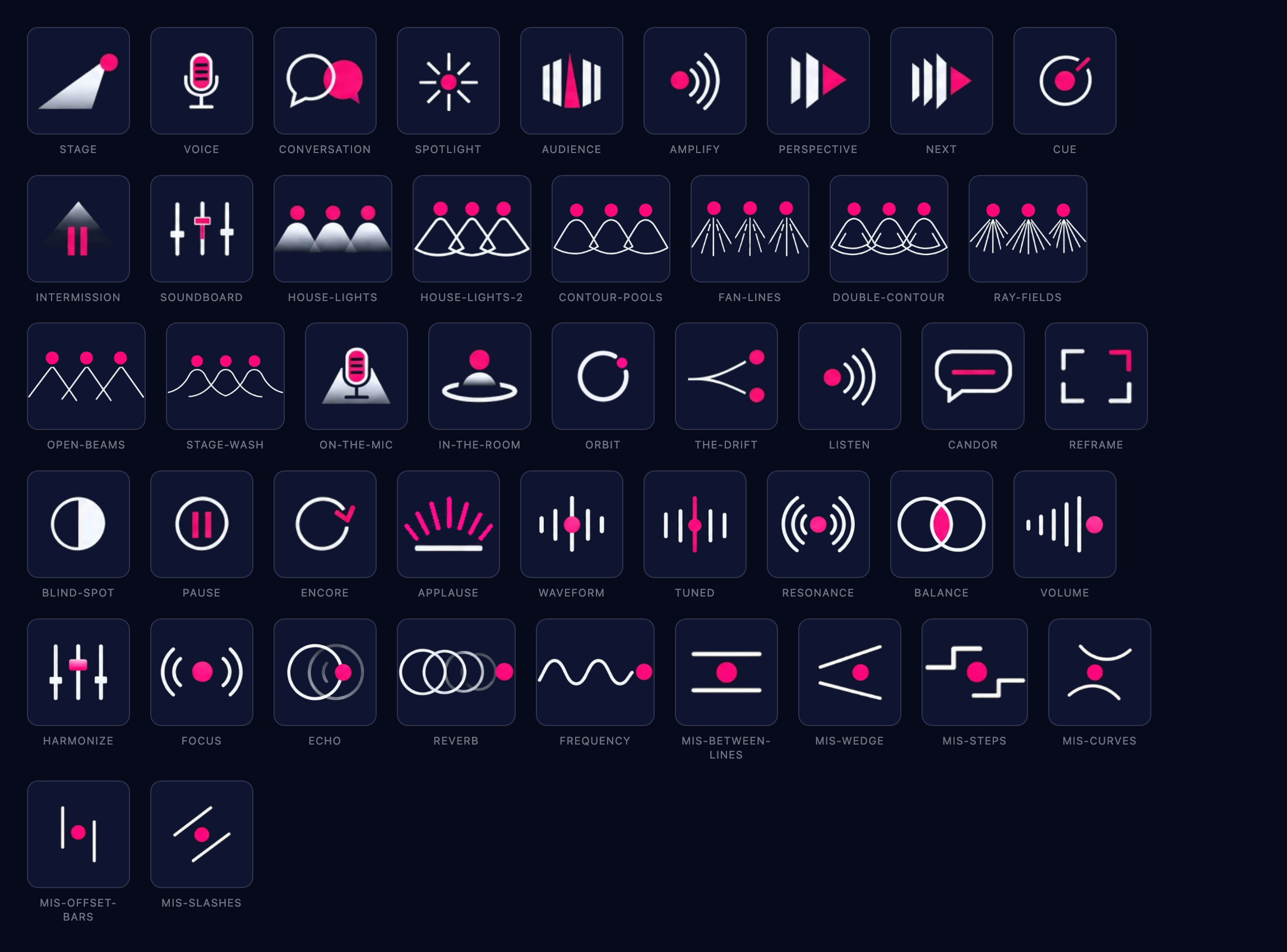
Core set on light
SPEAKS model

SPEAKS on stage

Services

Supporting

Formats & booking
Formats & booking on stage
Podium & audience

Podium & audience on light

Human experience

Human experience on light

TALK Tracks

TALK Tracks · the letter treatment (for copy blocks)

TALK on stage

Core values

Core values on light

The usual routes

The usual routes on stage

Team stories

Engagement journey

Outcome words

Credibility

UI utilities · all-fuchsia respec, no board originals

17 · Repeatable Elements
One Rhythm On Every Page
Hero top gap
48px between header and eyebrow at desktop, every page. Phones keep their stacked values.
Section rhythm
64 top and bottom on desktop, 48 top and bottom on phone, measured; logo strip 28/30 is the only exception. Zero gaps between bands; glows may bleed across joins. See Block anatomy.
Band rhythm
Every block reads as its own band, never one continuous scroll: even sections take the panel wash rgba(15,20,48,.5), every seam carries a 1px icy hairline at 7%.
Spotlights
On an orbit block, every practice chip holds a resting pool in its own light at equal presence, and every chip casts a beam in its light onto the rail on hover. Space is never the only light source.
Cards
Dark panels with cue corner light and edge light. Hover floats −4px with a deep shadow; rows float −3px. Hover-capable devices, motion allowed, only.
Pending marks
Caps chip (10px, gold) for status; italic serif dim line for placeholder copy. Never fake content.
Footer
Logo · Work with Dawn (cue dots) · Dawn Speaks · Contact (icons) · Follow (2×2 icons). Stacks below 1400.
Pressable
Fuchsia is the only pressable color: buttons, tap points, active tabs. Cues mark, they never press.
18 · Block Anatomy, Measured
All Blocks Share One Structure
Every block is built and checked against this drawing. The pink dimension lines are not typed in: they were measured from the rendered specimen, so the numbers are the real pixel distances. Desktop first, then phone (390). Title line height is Dawn’s approved 1.0 (House Lights, option A, chosen on the type specimen October 17).
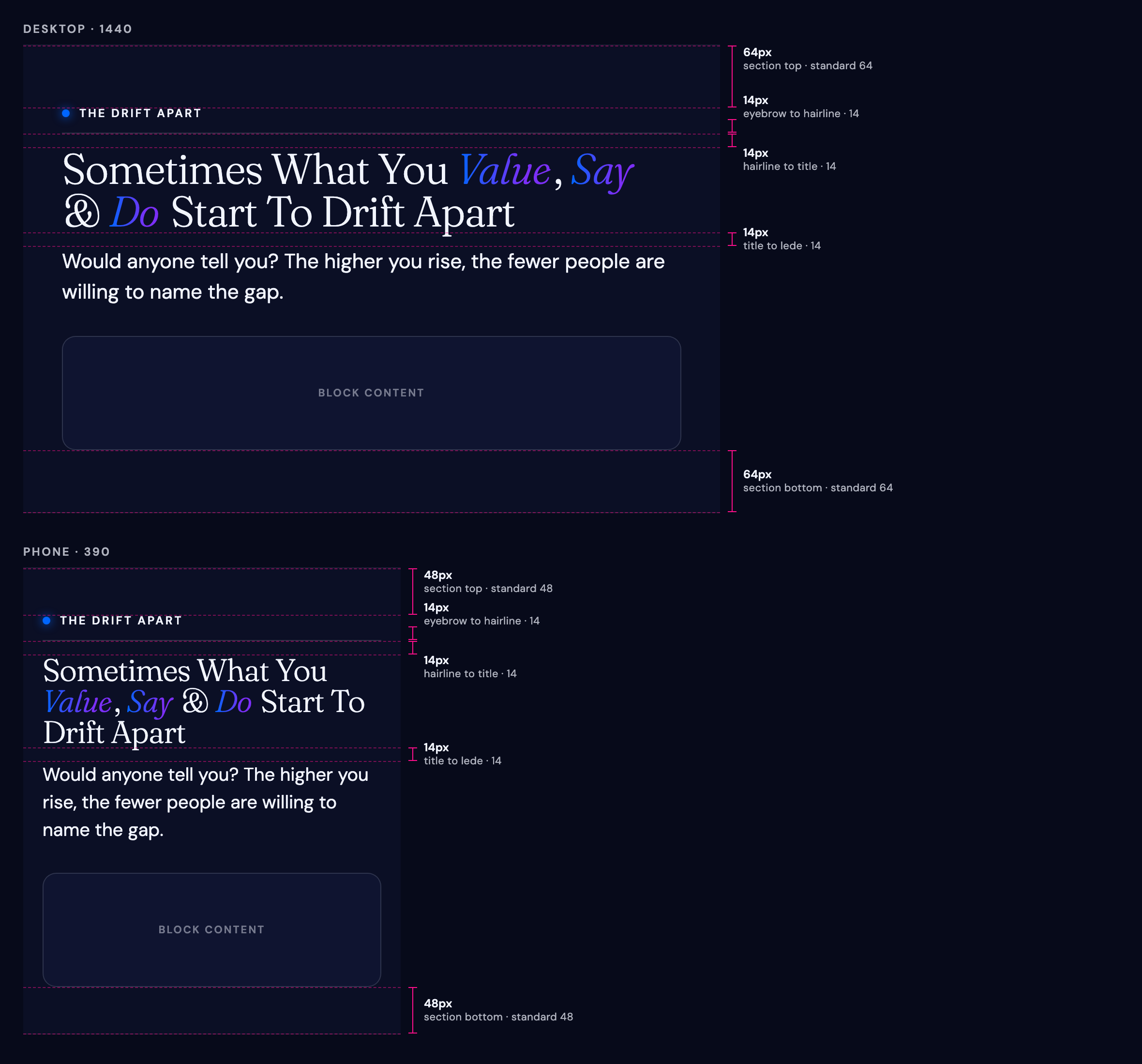
Read top to bottom: band edge → section padding → eyebrow (H3) → 14 → 1px hairline across the column → 14 → title (H1) → 14 → lede (H2) → block content → section padding → band edge. The eyebrow-to-title total is 29 (14 + 1 + 14) and only ever with the hairline; a bare 29px gap is wrong.
| Rule | Desktop | Phone (under 700) | Notes |
|---|---|---|---|
| Section padding | 64 top · 64 bottom | 48 top · 48 bottom | Measured on the band’s content wrapper. Nothing inside may add trailing space: no empty elements carrying margins, no padding under the last card or row. Zero gap between bands. |
| Eyebrow → hairline | 14 | 14 | Eyebrow set at line 1.0 (a 12px line), as on Home, so the text sits 16px above the hairline in rendered pixels on every page. 1px hairline rgba(242,245,255,.16), full column width, directly under the eyebrow. Never under the title. |
| Hairline → title | 14 | 14 | Dawn’s approved specimen sets the title 14 under the eyebrow; the hairline keeps 14 on each side. Same on every block on every page, including the orbit, the five stages, the weight bar, Track record and the work cards. |
| Title → lede | 14 | 14 | The lede is the line under the title, full column width. Never a side column beside the title. |
| Section title (H1) | Fraunces 300 44 · line 1.0 | 32 · line 1.0 | Dawn-approved line height. Full width, no character caps. |
| Hero title | Fraunces 300 64 · line 1.0 (56 mid, 52 tablet) | 44 · line 1.0, scaled down only to hold the title on its decided lines | Dawn-approved, House Lights option A. Where a title is decided on two lines (Home, Meet Dawn, Book Dawn), the phone size shrinks so each line fits the column: 36 Home, 42 Meet, 41 Book at 390. |
| Standard lede (H2) | DM Sans 400 21 · line 1.5 | 19 · line 1.5 | Full icy. Hero lede is its own role: Fraunces 300 28 (25 mid) / 22 at 1.25. |
| Eyebrow (H3) | DM Sans 600 12 caps · .16em | same | Full icy. 8px glowing dot in the page cue (fuchsia off the service pages, cobalt Executive, violet Team, turquoise Room). |
The dot: where it goes, where it never goes
The drift apart
Dot
Section eyebrow (H3) on every block. Page cue color.
For teams
Dot
Card and audience tags (work cards, Track record proof). Each in its own audience cue.
With Dawn
Dot
The “With Dawn” column of the usual-routes comparison.
For leaders
No dot
Hero eyebrow. Never had one; Dawn approved the hero without it.
Explore
No dot
The Explore label under the booking panel. It labels links, it is not a block eyebrow.
Lori, Consultant
No dot
Any credit under a quote, one line or name over role. A credit shares the eyebrow’s type, never its dot.
Exceptions, and only these
Logo strip
A strip, not a section: 28 top · 30 bottom, desktop and phone. Never on the 64/64 rhythm.
Booking panel + Explore
Read as one band: the panel opens at 64 (48) and keeps 0 bottom; the Explore links close the pair at 64 (48).
Intermission
A quote band: eyebrow, quote, credit. No title, no lede, by design. Same 64/64 (48/48) padding as every other band.
Hero
48 between header and eyebrow at desktop; phones keep their stacked values. Eyebrow 26 above the title, lede 16 under the title (Dawn’s approved House Lights A specimen), buttons 34 under the lede, at every width. Hero eyebrow has no dot. A two-line hero title holds its two lines on phones, so it may set under 44 there.
How a change is checked before it ships
1 · Measure, don’t read CSS
Render every page at 1440, 1000 and 390 and read the rendered pixels: padding, visible space to the first and last content, eyebrow → hairline → title, title → lede, every title’s size and line height, every lede’s size, every dot on the page by name.
2 · Check against Dawn first
Any type value is checked against what Dawn approved (the type specimen, option A) before this table. Where they differ, Dawn wins and Kris decides.
3 · Comps and WordPress together
A fix lands in the comps and in the WordPress drafts in the same round, and both are measured. Neither is “done” alone.
4 · Only what was asked
A standard applied to a block the request did not name is a proposal, shown to Kris first, never shipped.
19 · Motion & Interaction
How The Site Moves & Responds
Hover
Cards lift, fill with color, or glow when the cursor passes over them. Every word is already on the page, so nothing depends on hover.
Scroll
Drawn lines, like the three lines in The Drift Apart and the TALK Tracks path, start dark and light up as they scroll into view. Readers who turn off motion see them fully lit.
Open In Place
Tabs and answers, like a SPEAKS practice’s details or an FAQ, open in place, so the page never jumps.
20 · Words
Copy That Never Changes
- The four commitments, never pillars
- Practices, never steps, moves, or stages
- TALK written with no periods
- Always SPEAKS, never SPEAK
- The SPEAKS Model · the TALK framework
- Commas, not em dashes
- US English
- Copy owns every line; design places approved deck rows

